Chat Now
Chat Now
Welcome to online chat! If you have any questions or suggestions, please send them to us online, we will reply you as soon as we can!
submit

Language

English
Home

Blog

Blog

  • 8 Press Brake Machine Mistakes and How to Avoid Them
    Feb 13, 2026
    Something metal fabricators like to avoid is an upset ram. No, that’s not a distraught male sheep wandering in from the farm next door, it’s a press brake machine problem. The ram is an integral part of the press brake, and to say it’s upset means it’s bent. It’s bad news when parts of your machinery get bent because that makes it hard to form quality parts. Machines don’t have to be new to work well, but they do have to be cared for. Here’s a look at the importance of press brake maintenance. Putting in straight bends Sheet metal fabrications almost always go through the press brake. This is where we change it from sheet to a three dimensional shape. Those bends must be straight otherwise the final assembly won’t go...
    Hot Tags : top tool bottom tool
    Read More
  • How to avoid deviation in bending angle and size
    Feb 06, 2026
    For the bending process, the quality of the bending forming mainly depends on two important parameters: the angle and size of the bending. When bending, in order to ensure the forming size and angle of the bending, attention should be paid to the following aspects. (1) The misalignment of the upper and lower molds can lead to errors in bending dimensions. Before bending, it is necessary to adjust the alignment of the upper and lower mold tools. (2) After the left and right positions of the rear block are moved, the relative position between the sheet metal and the lower mold may change, which may affect the bending size. Before bending, the distance between the rear block positions needs to be re measured. (3) Insufficient parallelism between the workpiece and the lower mold can cause bend...
    Read More
  • 4 Common Mistakes Made When Operating a Press Brake
    Jan 29, 2026
        The press brake is one of the most useful and common sheet metal machines used on a fabricating floor. Its versatility for bending a variety of materials in different thicknesses and compatibility with a wide range of different press brake tools makes it a staple piece that can solely achieve dozens of different bends and shapes.   But if you don’t know what you’re doing, then, like any other sheet metal machine, a press brake can be a dangerous machine. Today’s article will highlight four common mistakes that are made by new press brake operators.   1.     Performing pre-work checks Something that every operator should get in the habit of doing is performing pre-work checks to ensure that all elements of the machine are in appropria...
    Read More
  • Bending Basics: 6 steps to successful die selection for press brakes
    Nov 24, 2025
    What inside bend radius you can achieve hinges on tonnage requirements and available die-opening widths     Figure 1 To get the most out of your press brake tooling, the tangent of the bend, where the radius starts, ideally should be halfway down the die face. In this situation, half the die face is equal to the outside setback (OSSB), the distance from the outside mold line (planes that run parallel to the workpiece) to the tangent point of the bend.   Question: Our fabrication department is documenting standard processes to select the correct punch and die combination to produce the desired results when air bending. We want to achieve a 90-degree bend for a 0.0751-in.-thick piece of 304 stainless steel with an inside bend radius that’s also 0.075...
    Read More
  • Press Brake Basics for New Operators
    Nov 09, 2025
    Press brakes are advanced forms of fabrication technology used for bending sheet or plate material, most commonly sheet metal. Successfully using one requires a detailed understanding of how the machine functions and the role of the person operating it.   If you’re new to working with press brakes, there are some important things to keep in mind:   Types of Press Brake The two most common types of press brake are hydraulic and electric:   Hydraulic Press Brakes: These are easier to use and come with a lower price tag. They are ideal for working with large, inexpensive materials that do not require high-precision bends. Typical pressure forces range from 40 to 600, and a hydraulic press brake will likely be your only option if you require a brake larger than 300 to...
    Read More
  • What material requirements should CNC press brake tooling meet?
    Oct 23, 2025
    To ensure the durability of CNC press brake tooling, the selection of materials is extremely stringent. Only materials that meet the following requirements are considered high-quality.   1. Wear resistance   This is a basic and crucial material property. During the production process, intense friction occurs between the mold surface and the workpiece. If the material is not wear-resistant, the CNC press brake tools will easily become damaged and fail.   2. Toughness   The working environment is relatively harsh, and the mold must withstand tremendous impact forces. Only strong and tough materials can withstand such impact without breaking.   3. High-temperature resistance   CNC bending tool operate in high-temperature environments, which can reduce their hardn...
    Read More
  • A press brake is a machine capable of bending metal sheets
    Oct 14, 2025
    A press brake is a machine capable of bending thin sheets. Its structure primarily consists of a support, a worktable, and a clamping plate. The worktable is mounted on the support and consists of a base and a pressure plate. The base is hinged to the clamping plate. The base consists of a housing, a coil, and a cover. The coil is located in a recess in the housing, and the top of the recess is covered by the cover. During operation, a wire energizes the coil, generating an attractive force on the pressure plate, thereby clamping the sheet between the pressure plate and the base. The electromagnetic clamping mechanism allows the pressure plate to be shaped to various workpiece requirements and can process workpieces with side walls, making operation very simple.   CNC press brakes and...
    Read More
  • What are the types of press brake tooling (bending machine molds )
    Oct 13, 2025
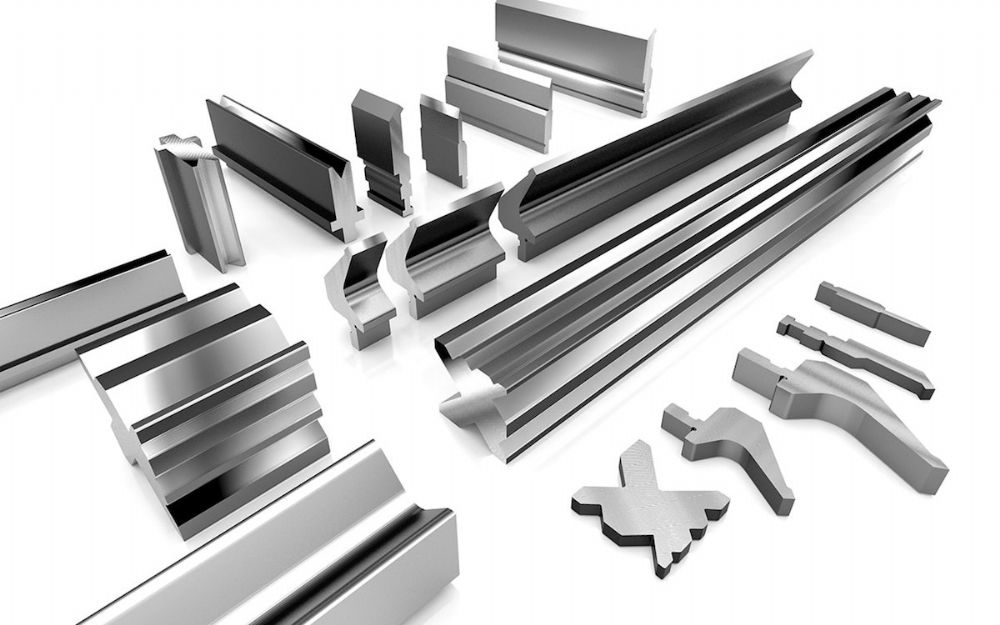
    Classification of commonly used press brake tooling: There are several types of bending tools, including L-shaped, R-shaped, U-shaped, Z-shaped, etc. The upper punch mainly has different angles such as 90 °, 88 °, 45 °, 30 °, 20 °, and 15 °. There are double and single slots with different slot widths of 4-18V in the lower dies, as well as R lower mold, acute angle lower mold, flattening tool set, etc. press brake tooling punch and die are divided into sections and whole parts: the upper punch is generally divided into sections of 300mm, 200mm, 100mm, 100mm, 50mm, 40mm, 20mm, 15mm, 10mm, and the whole is 835mm. The lower die is generally divided into sections of 400mm, 200mm, 100mm, 50mm, 40mm, 20mm, 15mm, and 10mm, and the whole is 835mm. ① Bending tools are made o...
    Read More
  • Maintenance and upkeep of the press brake
    Oct 11, 2025
    Before performing machine maintenance or cleaning, the upper punch should be aligned with the lower dies and the machine should be lowered and turned off until the work is completed. If startup or other operations are required, the mode should be selected as manual and safety should be ensured. The maintenance content is as follows:   1. Hydraulic oil circuit 1) Check the oil level in the fuel tank every week, and also check it after hydraulic system maintenance. If the oil level is below the oil window, add hydraulic oil; 2) The hydraulic oil used in this machine is ISO HM46 or MOBIL DTE25; 3) The new machine should have its oil changed after 2000 hours of operation, and every 4000-6000 hours of operation thereafter. After each oil change, the oil tank should be cleaned; 4) The syste...
    Read More
  • What are the key factors affecting bending accuracy?
    Oct 08, 2025
    Bending accuracy is a crucial technical specification for CNC press brakes. Key factors influencing bending accuracy include the sheet material, die-casting mold, machinery, and personnel. Let's discuss the specific aspects of these key factors:   Key factors for sheet metal 1. Straightness of the sheet metal's reference points 2. Is the stress distribution of the sheet metal uniform 3. Is the thickness of the sheet metal consistent   Key factors for die-casting molds 4. Is the accuracy of the upper and lower, left and right die-casting molds accurate 5. Is the lower die compensation device accurate and compatible with the frame design 6. The upper die fixture must be highly accurate.   Key factors for mechanical equipment 7. Straightness of the clamping opening of the press...
    Read More
  • Types of press brake dies Ⅱ
    Oct 06, 2025
    In the age of automation and Industry 4.0, press brakes are becoming increasingly versatile and crucial for a wide range of manufacturing sectors.   At the heart of these machines are the punches and dies, key tools that allow precise and repeatable bends to be made with a variety of materials. In this article we will look at the different types of dies   The dies used in press brakes are indispensable components in the sheet metal bending process. They are designed to make bends of various complexity, taking advantage of the efficiency of the press brake.   There are various models of dies for these machines, each with unique features and functions. They allow for both simple and more complex bends, helping to ensure accurate and high-quality results in sheet metal processi...
    Read More
  • How to Use a Press Brake
    Oct 05, 2025
    1. First, turn on the power, turn on the key switch on the control panel, and then press the oil pump to start. 2. Stroke Adjustment: When using a press brake, always pay attention to stroke adjustment and perform a test run before bending. When the upper die of the press brake reaches its lowest point, ensure there is a gap equal to the plate thickness. Failure to do so will damage the die and the machine. Stroke adjustment is available through both electric quick adjustment and manual fine adjustment. 3. Select the bending notch. Generally, choose a notch width that is eight times the plate thickness. For example, if you are bending a 4mm plate, you should choose a notch width of approximately 32mm. 4. Adjusting the back gauge is generally available through electric quick adjustment and...
    Read More
1 2
Get in touch
Have a project, need a helping hand?

Get in touch

Whether you need standard or custom tool, we support OEM & ODM & wholesale orders with competitive prices. If you don't know how to choose the tools for you workpiece, pls provide your workpiece size, plate thickness, radius,angle, material and so on.
submit

Chat Now

Chat Now
Welcome to online chat! If you have any questions or suggestions, please send them to us online, we will reply you as soon as we can!
submit
Contact Us :pressbraketooling@hotmail.com

Home

products

WhatsApp

contact